

On 10 April 2026, Elisabetta Marino led a six-hour teacher-training seminar at the University of Rome Tor Vergata as part of the Italian EcoLingua team’s work with future language teachers. The activity was reported alongside the contributions of Giulia Magazzù and Maria Grazia Maglione.
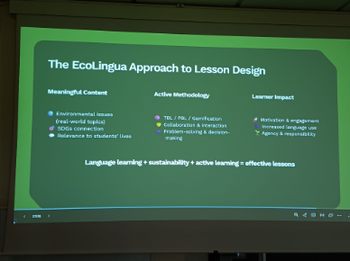
The seminar introduced the EcoLingua approach to lesson design. Participants considered how meaningful environmental content can be combined with active methods such as task-based language teaching, project work, gamification and collaborative learning. The aim was to connect language development with sustainability, learner engagement and responsible action.
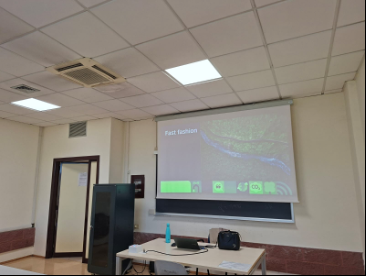
One presentation slide set out the relationship between environmental issues, active learning and learner impact. A classroom example on fast fashion then showed how a current environmental issue can provide meaningful content for language tasks, discussion and collaborative problem-solving.
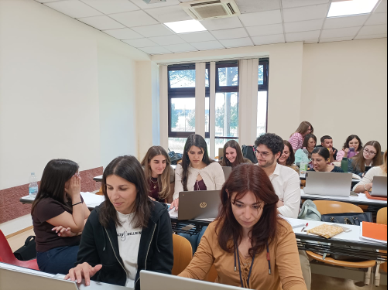
The classroom photographs document active participation throughout the session. Working with practical examples allowed the teacher candidates to discuss how environmental themes can be adapted to formal language-learning settings and connected with learners’ experiences.
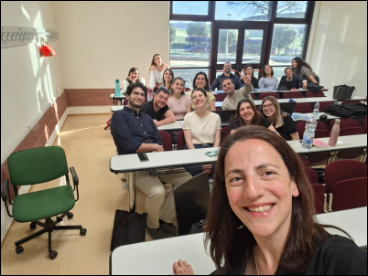
The seminar extended EcoLingua’s work in teacher education by giving future teachers a practical framework for integrating environmental questions into language lessons.